The lyric workshop
How to Write Song Lyrics: From Idea to Singable Draft
Learn how to write song lyrics with a clear viewpoint, concrete images, a memorable chorus, natural rhythm, and a practical line-by-line revision method.
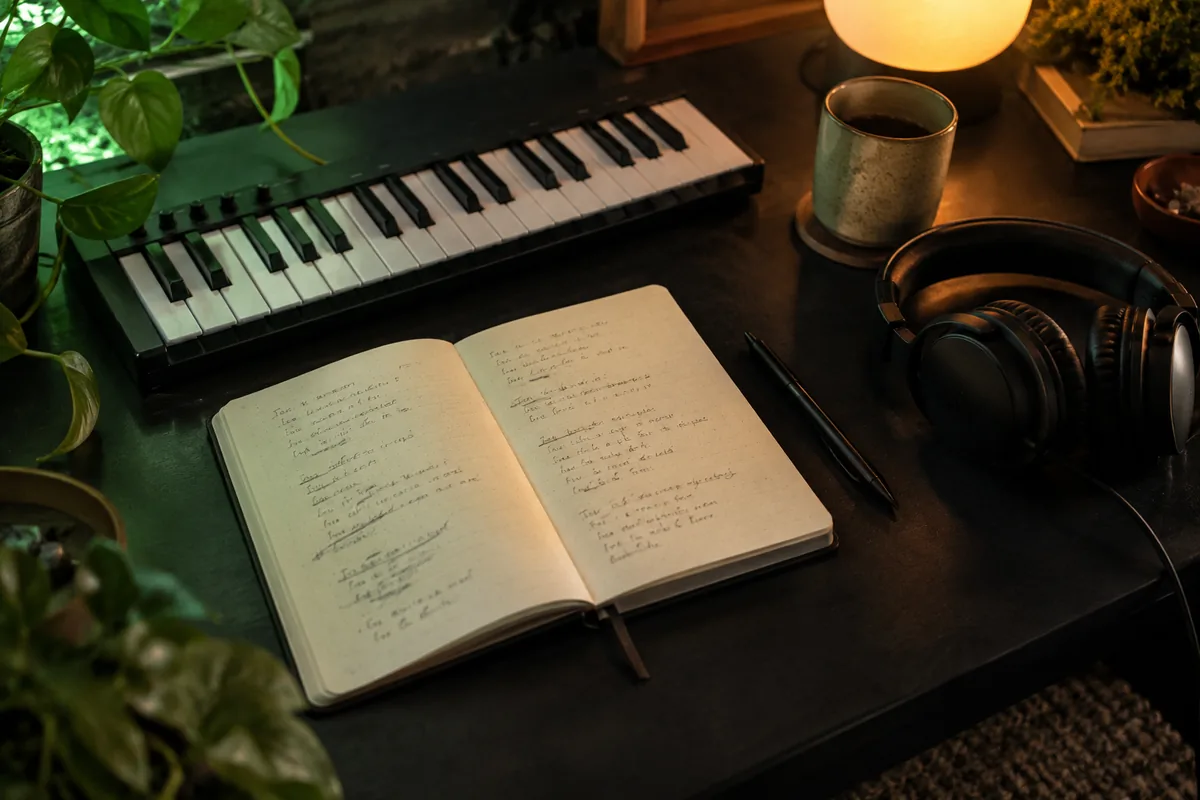
To write song lyrics, decide who is speaking, what they want to say, and which moment best shows it. Build a chorus around the main thought, use verses to develop the situation, and read or sing every line aloud. Revise for meaning and phrasing before polishing the rhyme.
You do not need to make every sentence poetic. You need words that belong to this speaker and work when performed. This workshop develops an original idea called “Room for One More” and shows how to move from a broad feeling to an editable lyric sheet.
1. Give the lyric a speaker and a listener
“A song about friendship” leaves many decisions open. Try this instead: “I am inviting an old friend back to our usual table after we have barely spoken for months.” Now you have a speaker, a listener, a place, and a reason to speak.
Write the following at the top of your page:
- I am: someone who wants to reconnect.
- I am speaking to: a friend who may think they are no longer welcome.
- I want them to know: there is still a place for them.
- The moment is: just before they arrive at a small gathering.
Keep the perspective steady in the first draft. If “you” means the friend in verse 1, avoid switching it to a different person in the chorus without a clear reason. A listener cannot see the notes in your head.
2. Collect evidence for the feeling
Before writing lines, list a few things the speaker could actually notice: a spare chair, a chipped blue mug, a coat hook left empty, a message that says “Are you still awake?” Choose details that help tell this particular story.
Andrea Stolpe's lyric-writing lesson at Berklee Online recommends using sensory detail to place listeners inside a moment. For this exercise, use one object as evidence of an emotion rather than listing all five senses.
Compare these two original drafts:
Broad: I miss you and I want us to be friends again.
More specific: I pulled your blue chair closer to the table.
The second version gives the singer an action. It does not need to explain every feeling immediately. The chorus can tell us what that chair means.
3. Write the chorus in plain language first
The chorus usually carries the thought you want the listener to remember. Say it without rhyme: “You can come back even if we do not have everything figured out.” Then try a few short phrases that could hold that meaning.
For “Room for One More,” here is an original four-line sketch:
There's room for one more at the table
Your chair is still close to mine
We don't have to fix the whole story
We can start with tonight
The title phrase offers a concrete invitation. The final line makes that invitation manageable. There is no strict end-rhyme scheme here; the first job is to communicate a thought someone might want to sing again.
Try two other endings. One could ask a question; another could make a promise. Keep only the version that fits your speaker. The hook generator can offer a short chorus draft within the shared free lyric allowance, but the emotional decision remains yours.
4. Let each verse bring new information
Make a one-sentence plan for each verse before filling the lines:
- Verse 1: the speaker prepares the room and wonders whether the friend will come.
- Verse 2: the friend arrives, and their ordinary greeting makes the distance feel smaller.
- Optional bridge: the speaker admits why they waited so long to reach out.
A first-verse fragment might be:
I moved the boxes off your usual chair
Then checked my phone as footsteps climbed the stair
Verse 2 should not repeat those actions. Perhaps the friend brings the same cheap cake they always used to bring. That detail changes what the listener knows: the shared history is still present.
If a verse contains a sentence that simply restates the chorus, try replacing it with an action leading toward that thought. The full songwriting guide explains how these sections can connect to a melody and a complete structure.
5. Make the words fit natural speech and melody
Read each line conversationally. Underline the words you naturally emphasize. Tap a steady beat and speak it again. If you have a melody, sing the line at the intended tempo and notice where you rush or run out of breath.
Take the first chorus line: “There's ROOM for one MORE at the TAble.” If the melody puts its strongest emphasis on “for” or the last syllable of “table,” the phrase may sound less natural. You can move a note, change the rhythm, or rewrite the line.
Counting syllables can help compare lines that share a melody, but equal counts do not guarantee matching stress. “I saved a place” and “Remember me” each have four syllables in ordinary speech, yet their stress patterns are different. Always test the performance.
For a long held note, choose a word you can sing comfortably and want the listener to notice. Do not save the most important thought for a breathless string of tiny syllables at the end.
6. Use rhyme to support meaning
Write the sentence you mean before choosing its rhyme. Then look for an ending word that keeps that meaning intact. If a rhyme requires an unnatural sentence or an irrelevant detail, loosen the rhyme or change the line.
For our verse, “chair” and “stair” connect two actions in the same scene. If you added an “affair” only because it rhymes, you would introduce a different story. That is a useful warning sign.
You can try paired endings, alternating endings, near rhymes, or passages with little end rhyme. Repeated rhythm and a returning title phrase can also provide cohesion. Pick the pattern that helps this song rather than treating one scheme as a requirement.
7. Revise in separate passes
Trying to fix story, rhyme, melody, and spelling at once makes every line feel negotiable. Use four focused passes instead:
- Meaning: can someone explain the situation after one listen? Clarify confusing pronouns and missing connections.
- Movement: does each verse add something? Remove a repeated explanation or give it a new action.
- Performance: sing at tempo. Shorten crowded phrases and mark breaths.
- Sound: refine rhyme and repeated consonants without changing the story accidentally.
For a practical before-and-after, take “I am experiencing a feeling of isolation.” In this song, you might replace it with “I set one cup out, then reached for two.” That does not make the second line universally better; it makes it more useful for a story about making space for someone.
Save the earlier version. If the rewrite sings more smoothly but loses the original feeling, you can recover the stronger thought and try another phrasing.
Turn the draft into a lyric sheet
Label the sections [Verse 1], [Chorus], and [Verse 2]. Put each sung line on its own line. Keep production notes separate so a collaborator can distinguish the words from instructions. Add a working title and the date.
For a title-led approach, read how to write lyrics from a title. If you want an editable starting draft, the AI lyric writer works without login within its daily allowance. Check the images, perspective, and stress rather than accepting every line automatically.
When you are ready to hear a rendition, Lyrics to Song accepts your lyric sheet. Editing is free; music generation requires login and 100 credits. You can also sing and record the lyrics yourself using the home production guide.
Questions about writing lyrics
Can I write lyrics without playing an instrument?
Yes. Speak, tap, hum, and record your lines. A voice recording reveals phrasing that is easy to miss on the page. You can work with a musician later or develop the melody yourself a few notes at a time.
How long should song lyrics be?
There is no required word count. Tempo, repetition, pauses, and delivery change how many words a song can hold. Start with two short verses and a chorus, perform them, and add a section only when it contributes a new idea.
What if every line sounds like a cliché?
Choose one line and ask what actually happened. Replace a broad phrase such as “you were always there” with an action that proves it. For more exercises, use the songwriting tips and work on one problem per session.