Song Idea Generator: What to Write a Song About
Find what to write a song about with a practical scene-and-conflict exercise, 24 original topic seeds, and a method for turning one idea into a chorus.
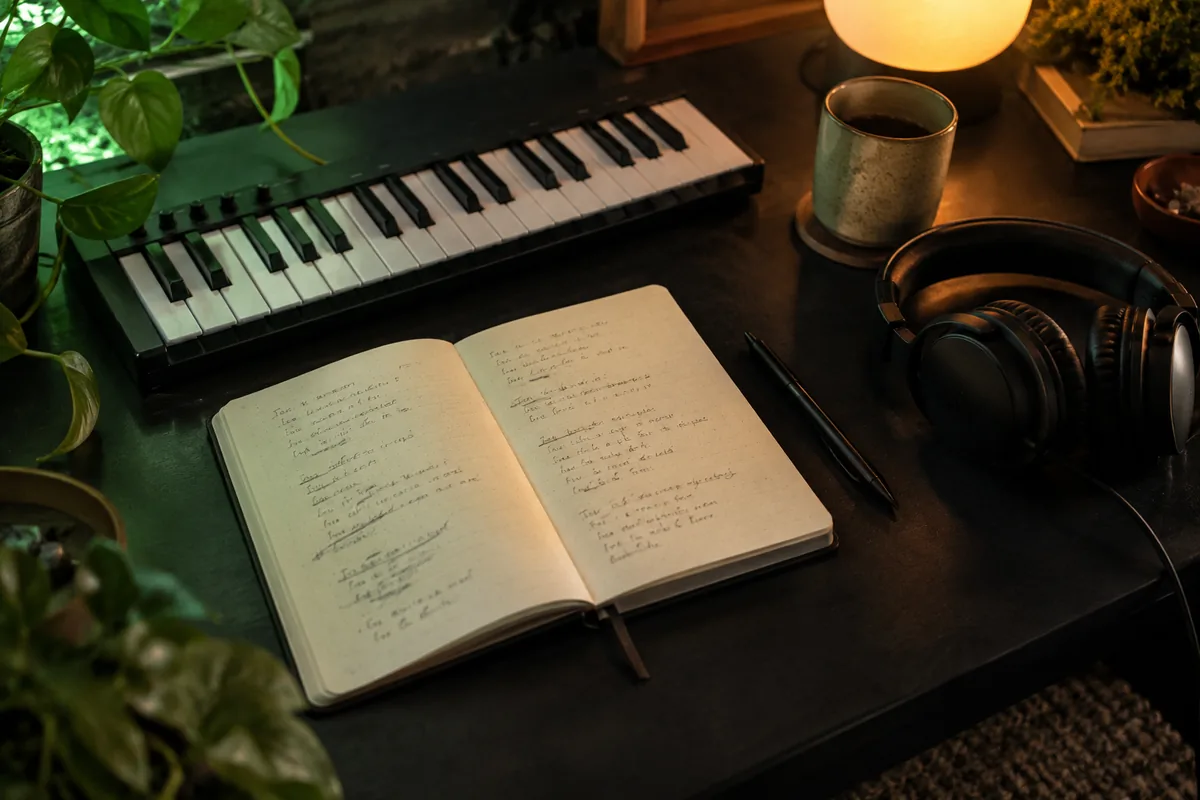
If you do not know what to write a song about, combine a person, a place, and a small unresolved action. “Someone returns a borrowed key at a station” already contains more possibilities than “a song about change.” Then choose what the speaker wants the listener to understand.
Think of this page as a song idea generator made of prompts and choices, not an automatic audio tool. You can work through the exercise on paper and leave with one clear brief for a lyric, melody, or full song.
Build an idea from four decisions
Choose one item from each group, then write a sentence connecting them.
| Person | Place | Wanted action | Obstacle |
|---|---|---|---|
| An old friend | A late bus stop | Say thank you | The bus is arriving |
| A new neighbor | A shared staircase | Ask for help | They have never spoken |
| A tired traveler | An empty café | Call home | The phone is almost flat |
| Someone moving out | A kitchen doorway | Return a key | They still want to stay |
| A sibling | A childhood garden | Tell the truth | Everyone is celebrating |
You do not need to use the combinations exactly. The choices are there to remove the empty page, not to make every writer tell the same story. Change the action when the first combination feels too familiar.
For example: “An old friend at a late bus stop wants to say thank you before the last bus leaves.” The chorus might be about words that arrive late. The verses can show the speaker trying to find them.
Turn a subject into a point of view
A subject names an area: home, friendship, ambition, loss, summer. A point of view gives the song a position: “I thought leaving made me independent, until I started repeating the little rituals from home.”
Ask three questions: Who is speaking? Who are they addressing? What do they understand by the end that they did not understand at the start? You can answer with a question or an uncertainty; the narrator does not need to solve everything.
The complete songwriting guide shows how a small situation can lead to a chorus and verse structure. If you already have a phrase in mind, the title-led workshop gives another route into the draft.
Twenty-four song topic ideas to develop
Relationships and ordinary care
- A friend who always sends the last message after everyone gets home.
- Two people who disagree about directions but keep taking walks together.
- A parent recognizing a grown child's handwriting in a note.
- A neighbor who waters the plant after the owner moves away.
- A reunion where the first joke is still the same one.
- A person learning how someone else takes their tea.
Choose one action that could appear in the opening verse. “Being a good friend” is the subject; waiting until the final train is an action that can show it.
Change, place, and belonging
- The first meal cooked in an almost-empty apartment.
- A hometown shop with a new name and a familiar smell.
- A key that no longer opens the door it was kept for.
- Two people using different words for the same home.
- A coat pocket containing a ticket from a finished journey.
- A room that becomes less frightening after someone laughs in it.
Try writing the scene without explaining the emotion. Decide later whether the chorus should name it directly. Andrea Stolpe's Berklee lyric-writing lesson recommends sensory detail as a way into a moment. Here, the object should help your particular story rather than decorate every line.
Humor and small frustrations
- An alarm clock convinced it is the manager of your life.
- A group chat that takes three weeks to choose dinner.
- Someone who labels the leftovers and forgets their own name tag.
- A houseplant holding a very polite performance review.
- The printer that only works when a witness arrives.
- A shopping list slowly becoming a love letter.
For humor, identify the narrator's mistaken belief. A printer that thinks it is an artist is a more specific character than a machine that is simply annoying. Keep real people recognizable only when they are comfortable with the joke.
Possibility, doubt, and imagination
- A city that hears its first quiet morning in years.
- Someone rehearsing an apology to an empty passenger seat.
- A message written but never sent, discovered much later.
- A small café staying open for one uncertain customer.
- A lighthouse keeping a diary of everyone it cannot meet.
- The night before someone returns to a hobby they abandoned.
Imaginary narrators can carry real feelings. Give them something physical to do so the lyric has a scene as well as an idea.
Choose the idea with somewhere to go
An idea does not have to be unusual to be worth writing. Check whether it gives you a present moment, a tension, and a possible change. Score nothing; simply finish these sentences:
- “At the opening, the speaker is doing…”
- “The thing they cannot easily say is…”
- “By the last chorus, the same phrase could mean…”
If all three answers are vague, make the scene smaller. If you have five competing stories, select the one with the clearest action and save the others. A single song can hold complexity, but a first draft benefits from a decision.
Make a chorus thought before a perfect title
For the old-friend bus-stop example, a plain chorus thought could be: “I should have told you sooner, but I can still say it now.” Try three returning phrases: “Before the Last Bus,” “A Little Late to Say,” and “Wait One More Minute.”
Each phrase shifts the focus. The first emphasizes the scene, the second the delay, and the third the request. Choose the angle you want to sing. A song name generator can suggest browser-made title combinations without AI credits, but it does not analyze the meaning of your entire lyric.
Take one idea into a draft
Write a brief containing the narrator, scene, chorus thought, and two details. For example: “An old friend at the last bus stop wants to say thank you. Mention a folded umbrella and the empty seat beside the driver. The chorus asks for one more minute. Conversational, hopeful, no invented backstory.”
You can develop that idea in SongLab through an anonymous lyric draft within the shared daily allowance. Edit the text before considering music; rendered music requires login and 100 credits per generation. The exercise itself works without generating anything.
Questions about finding song ideas
What should I write a song about if my life feels ordinary?
Look for a moment when an ordinary action meant more than expected. A spare cup, a repeated walk, or a delayed reply can hold a clear emotional change. The scale of the event is not the same as its meaning.
Can a random topic become a personal song?
Yes. Treat the random combination as a door, then replace details with observations you recognize. Keep the part that produces an honest viewpoint and discard what feels forced.
How many ideas should I develop at once?
Keep a list, but choose one central thought for the current draft. If two ideas pull the chorus in different directions, give them separate pages and see which one develops more clearly.
What if my idea resembles another song?
A broad subject can be shared by many songs. Develop your own words, melody, narrator, and details rather than copying an existing expression. Save your drafts so you can follow how your choices developed.
SongLab editorial workshop, reviewed November 3, 2026. Topic seeds and examples are original; the linked Berklee lesson supports the narrow discussion of sensory detail.